
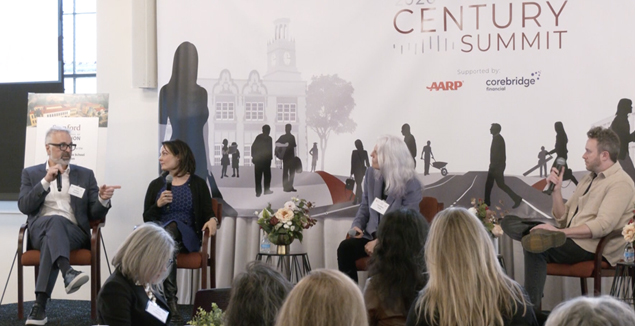
The traditional model of "filling the tank" with education early in life is no longer a sustainable model for a changing world, according to College of Lifetime Learning Dean Bill Gaudelli, who spoke recently at Stanford University.
The traditional model of "filling the tank" with education early in life is no longer a sustainable model for a changing world, according to College of Lifetime Learning Inaugural Dean Bill Gaudelli.
During the Stanford Center on Longevity's Century Summit, Gaudelli discussed how a “design science” approach can reshape the future of learning and aid institutions in evolving beyond traditional processes to support learning across a lifetime.
"The idea of filling the tank for four, six, or even 12 years and then hoping that lasts for a lifetime just doesn't work," he said during the Enabling Learning Across the Life Course panel.
Moving Beyond Traditional Models
Gaudelli described a future where higher education moves beyond a traditional degree pathway and creates responsive learning systems built around how people actually learn.
“Learning always occurs indirectly, by means of an environment where the student, as sovereign, apprehends knowledge from a learning environment," he said. "That's a very different theory than what operates on most university campuses.”
Gaudelli explained that Georgia Tech's goal in establishing the College of Lifetime Learning wasn't just to build a new college but to "recreate the entire university system." In order to do that, the College must develop a deeper understanding of how learners engage with educational environments and use those insights to improve learning opportunities.
“We want to get really fine grained in following the learner, the data that comes out of the learning analytics or the moves that they make — their behavior — and collect that data and use that to optimize insights across the platform,” he said.
With those plans in mind, Gaudelli noted that learning research is a core institutional priority within the College.
"Learning is really the center of the research core of what we do," he said. "[We’re creating] a college that is specifically focused on learning optimization — the way in which we can use the tools that we now have to achieve that end. ... I think people have begun to recognize the failure of the previous system, and they want a new system that can create a more optimal environment. That's what we're aiming to do.”
Creating Access in A Changing World
The conversation also touched on artificial intelligence and its potential to transform both teaching practices and organizational operations. Gaudelli noted that AI has the potential to make universities more adaptive and even encourage institutional reflection.
"If we're going to project learning into the world and say, ‘This is why it's so valuable; this is why it contributes to human flourishing,’ then we ought to be living it inside those institutions,” he said.
Throughout the discussion, Gaudelli emphasized that access and affordability are also essential to the College's mission. He pointed to Georgia Tech's Online Master's of Science programs and praised the efforts of the state of Georgia in keeping learning opportunities attainable.
"One of the reasons we're creating the College of Lifetime Learning is so that we can reach communities across the state and across the world," he said. "It's all about affordability and access, and we've got to live that.”
Author: Kat Bell