
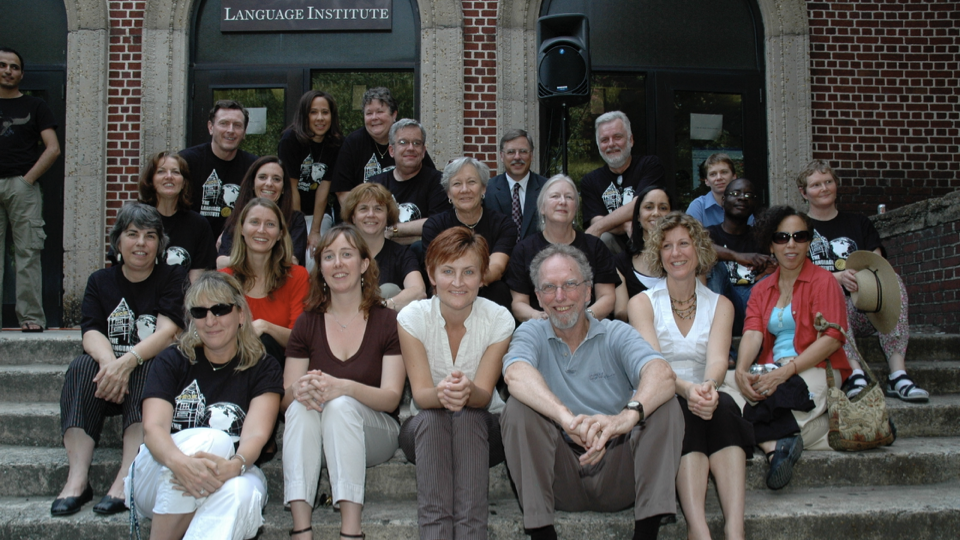
Years of experimentation, collaboration, and leadership from across the Institute ultimately led to the creation of of the College.
Long before it carried the name College of Lifetime Learning, the idea that education shouldn't stop at graduation was taking shape across Georgia Tech. Over decades, that belief turned into models for online and distance learning, scalable education, and what it means to truly learn throughout one's life — beliefs that formed one of the Institute's most forward-thinking efforts. The vision of the College of Lifetime Learning didn't emerge overnight, but through years of experimentation, collaboration, and leadership from across the Institute. One of those leaders was Nelson Baker, who helped lay the groundwork for this revolutionary college.
Building a Community at Tech
At Baker's retirement celebration this January, President Angel Cabrera summed up Baker's commitment to Tech, saying, "There are people who go to Georgia Tech, graduate, and do good things. There are people who go to Georgia Tech and engage with Georgia Tech. There are people who go to Georgia Tech, engage with Georgia Tech, love Georgia Tech, and do lots of things for Georgia Tech ... and then there's Nelson. He's in a whole new category."
A Georgia Tech alumnus who first arrived on campus as a civil engineering student, Baker returned to his alma mater as a faculty member in 1989. In his early years at Tech, he mentored civil engineering doctoral students, published research on effective teaching with technology, and searched for new ways to make education accessible for all
"He dared us to think," said one of those students, Michael Bertz. "When I wanted to challenge the School of Civil Engineering's faculty to consider a different vehicle for learning high-level concepts, he urged me to come with data, but to be courageous. His impact on us, in those formative years, has guided student after student as we've gone out into our careers."
A People-First Approach
A decade before the launch of Georgia Tech's first scalable online degree, Distance Learning and Professional Education (DLPE) staff were already honing in on the impact scaled learning could have on the higher education landscape. Then-Vice Provost William Wepfer saw the work Baker was doing with his multimedia tutoring program and research studying knowledge retention and transfer in relation to technology. Convincing him to apply for the DLPE associate vice provost position, Baker remembers Wepfer saying, "I hear you do some things for 30 students at a time. What if you did something for students much greater than that, larger numbers? Take your research and put it into practice."
With each reappointment cycle, Baker took a step forward within DLPE. Stepping into the role of vice provost, Baker's focus was on helping professionals prepare for the ever-changing workforce. “We need to be doing more to help people learn more effectively and to prepare them for the workforce of tomorrow,” he said after starting as vice provost in 2008. “I believe that means not just [for] undergraduate and graduate students, but for individuals from commencement to post-retirement.” Baker maintained this as his mission when DLPE officially became Georgia Tech Professional Education (GTPE) in 2012, and he was appointed dean.
From the start, Baker has been committed to helping people learn more effectively, regardless of whether they fit the mold of a traditional student. During the over two decades of Baker's leadership, DLPE, now GTPE, has made advancements in higher education and lifetime learning, including Georgia Tech's high school dual enrollment distance calculus program, the launch of three online master's of science and three professional master's degrees, and more than 650 non-credit courses, programs, and certificate series.
"Learning needs to be at the center, because that's really the student focus," Baker said. "We can teach all day long, but it's what the person leaves with that impacts their life and those around them."
Creating a College Dedicated to Learning
In 2023, Baker was awarded the most prestigious UPCEA award, the Julius M. Nolte Award for Extraordinary Leadership, for his recognition as a global thought leader and contributions to the growth of accessible, affordable, and high-quality online programs. That same year, his decades of work culminated in what some may consider his biggest achievement, the creation of the division of Lifetime Learning, which officially became a college the following year.
As inaugural interim dean of the College of Lifetime Learning, Baker's mission became helping "young minds think about a future they can't imagine." Combining GTPE, Georgia Tech Savannah, the Center for 21st Century Universities (C21U), and the Center for Education Integrating Science, Mathematics, and Computing (CEISMC), he brought together faculty and staff dedicated to the idea that learning was an untapped discipline within higher education and research.
Reflecting on Baker's work with the college before he joined Georgia Tech, Inaugural Dean William "Bill" Gaudelli said, "The thing that resonates for me when talking with Nelson is that this was always mission work. He not only changed his own career trajectory, he changed that of his alma mater. And that is very, very powerful."
Now, as Georgia Tech and the College of Lifetime Learning enter a new chapter, the work that Baker and his colleagues have long been advocates of continues through Strategy 2035, which will provide a roadmap for how the school will advance learning across the lifespan and contribute to a future in which education is more accessible, adaptable, impactful, and striving to advance the human condition.
"We're running a relay race," Baker said at his retirement celebration to Gaudelli. "The baton is in your hands now, and I know they're extremely competent and extremely ready for the race that's ahead. And what a race it will be."
Author: Kat Bell