
Artificial intelligence (AI) can prompt a student to reconsider an answer. It can also help a healthcare professional practice responding to a challenging workplace event.
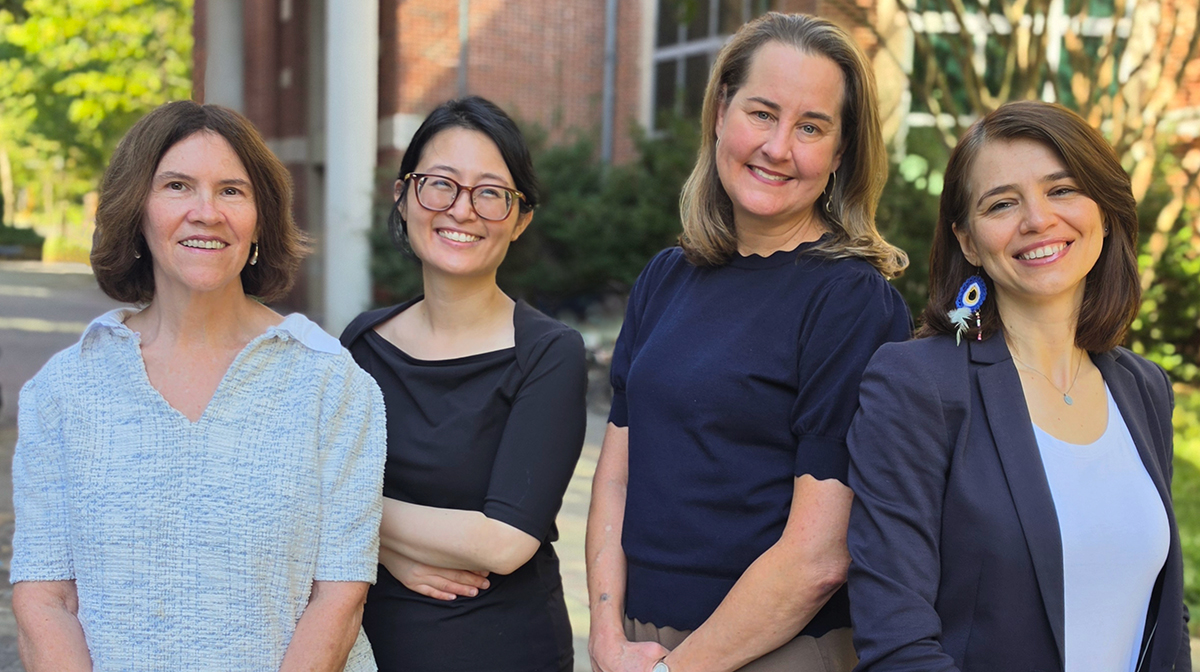
Two Georgia Tech projects explore those distinct possibilities. College of Lifetime Learning researchers Meryem Yilmaz Soylu and Jeonghyun “Jonna” Lee collaborated with School of Biological Sciences lecturer Lesley Baradel to study AI-facilitated Socratic dialogue in large courses. In a separate project, Karen Peterson, a principal lecturer in the College of Lifetime Learning, used AI to develop clinical scenarios, pronunciation feedback, and vocabulary exercises for healthcare communication courses.
Both projects are featured in Georgia Tech’s first Academic AI Playbook, which shares practical examples of how faculty are using AI to support specific learning goals.
Encouraging Students to Think More Deeply
“One of the things that interested me most was the opportunity to extend meaningful academic conversations beyond the time and space available in a classroom,” Baradel said. “Using Socratic Mind in my classroom showed me how AI can facilitate reflection and discussion at a scale difficult to achieve through one-on-one interactions alone.”
Socratic Mind is an AI-powered conversational assessment tool developed by researchers in Georgia Tech’s College of Computing and College of Lifetime Learning. The team piloted the tool with more than 700 students in online and in-person courses. Their research examined whether AI could help students engage more deeply with course concepts by prompting them to explain their reasoning, apply their knowledge, and identify gaps in their understanding.
In Using AI-Facilitated Socratic Dialogue for Formative Learning in Large Undergraduate Courses, Baradel, Yilmaz Soylu, and Lee document the long-term collaboration among the instructor, researchers, and students to better understand how the tool may influence learning at cognitive and behavioral levels.
“Being part of the AI Playbook is especially meaningful because it allows us to share the idea behind the project and what we learned from putting it into practice with colleagues across Tech,” Yilmaz Soylu said. “Readers will see outcomes from research guided by student feedback and interaction data, which continually refined the activity and helped us better understand what makes AI-supported dialogue significant for learning.”
Building Communication Skills by Practice
In AI-Supported Healthcare Communication Training, Peters describes how she used AI to provide healthcare professionals and nurses with opportunities to develop communication skills through learning activities. Those skills include AIDET (Acknowledge, Introduce, Duration, Explanation, and Thank You) and SBAR (Situation, Background, Assessment, and Recommendation). She used generative AI to identify relevant healthcare vocabulary, develop instructional materials, create realistic clinical scenarios, and design activities tailored to students’ vocabulary gaps.
“One of the most important lessons from this work is that AI should be used to support a specific learning objective, not simply because the technology is available,” Peterson said. “When implemented intentionally, AI can help create more personalized opportunities for practice and feedback while supporting the learning goals that matter most.”
Keeping Learning at the Center
Results from the Socratic Mind pilot indicated that AI could promote greater engagement when it challenges students to think through and revise their ideas rather than simply providing answers. Peterson’s work expanded access to authentic healthcare communication experiences, giving learners opportunities to engage in workplace interactions that are difficult to replicate with traditional instructional materials.
“Beyond the classroom outcomes, the Socratic Mind project generated valuable insights into how students engage with AI-guided educational experiences,” Lee said. “Those findings contribute to a growing body of research that helps educators better understand when and how generative AI can support meaningful learning and inform its thoughtful use in higher education.”
Together, these projects demonstrate that AI’s value in education goes beyond efficiency or automation. Whether prompting students to reflect more deeply on course concepts or helping healthcare professionals practice high-stakes communication, the most effective applications are grounded in clear learning goals. AI can enrich teaching and learning when intentionally designed to support meaningful engagement, practice, and feedback.
“Rather than replacing existing teaching practices, AI prompted me to reconsider which aspects of the learning experience benefit most from human expertise and which can be enhanced by technology,” Peterson said. “It also opened new possibilities for designing learning experiences that are both responsive and scalable.”
Interim Vice Provost for AI in Education David A. Joyner and Nimisha Roy, a lecturer in the School of Computing Instruction, edited the 2026 edition of the Georgia Tech Academic AI Playbook. The authors of the featured articles, Peterson, Baradel, Yilmaz Soylu, and Lee, hope their work will inspire new ideas for using AI thoughtfully and purposefully to support teaching and learning.