
Conversations about artificial intelligence in education are unfolding across Georgia Tech, influencing classroom experiences, shaping student behavior, and raising important questions about the future of learning.
To address those questions, Provost Raheem Beyah convened the Committee on AI Instruction and Education, bringing together faculty, staff, and students to help inform how the Institute can lead in the age of AI. The committee aimed to equip instructors and students with the strategies, tools, and judgment needed to use AI responsibly and effectively.
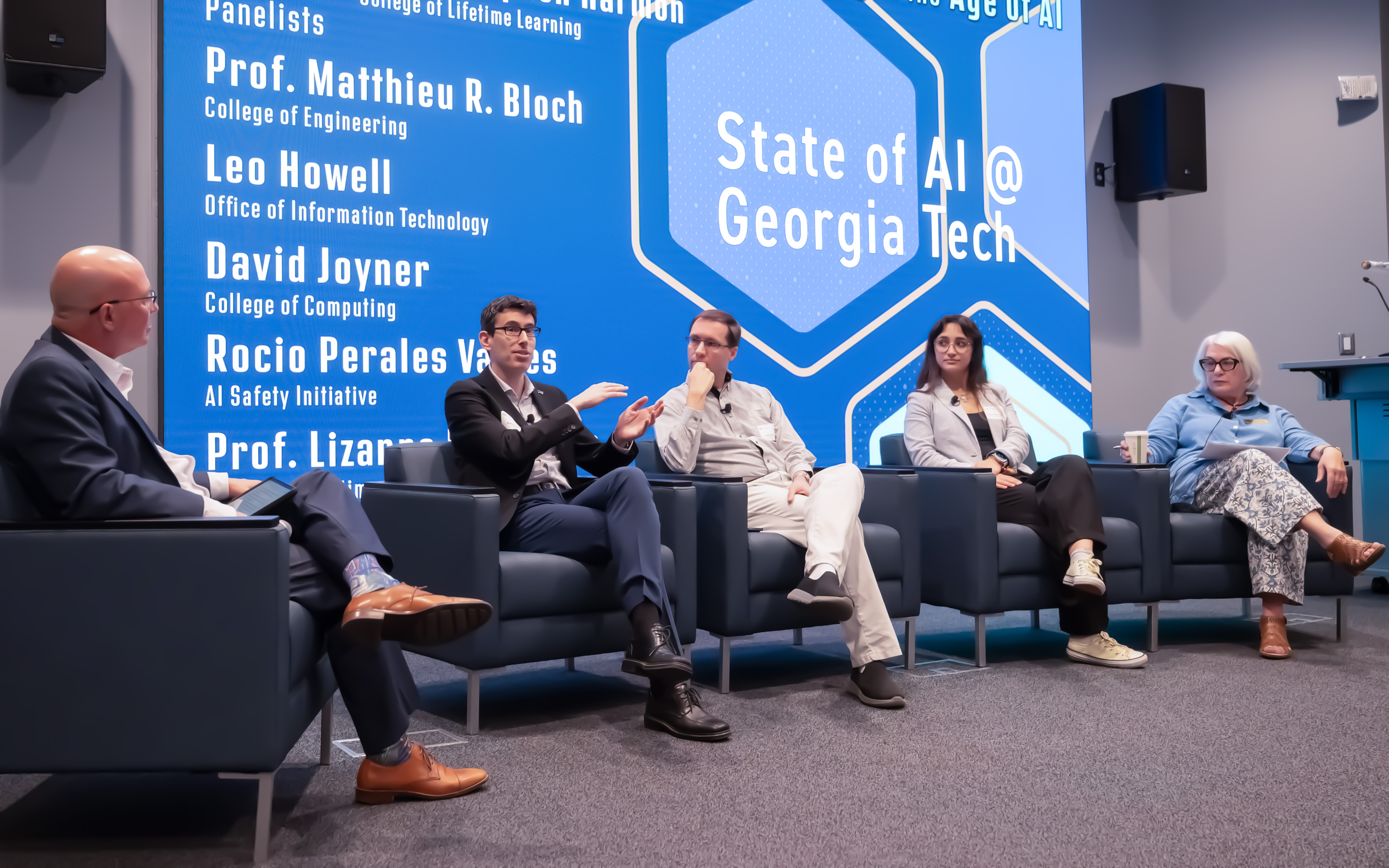
During the College of Lifetime Learning symposium, Skilling, Upskilling, and Reskilling in the Age of AI, committee members shared perspectives from their subcommittee work. Together, their insights highlighted how Georgia Tech is exploring ways to enhance learning with AI while preserving the critical thinking and human judgment that define a Georgia Tech education.
AI's Role in Teaching and Learning
Faculty perspectives on AI vary widely. Some remain cautious, while others are experimenting with new approaches tailored to their disciplines.
"It goes all the way from some saying, 'over my dead body,' to others who are really embracing it," said Matthieu Bloch, associate dean for Academic Affairs in the College of Engineering and leader of the AI for Teaching and Learning subcommittee. "We're not a monolithic group, and that means we'll move forward with very different perspectives on what AI can do, both for good and for bad."
Those differences often reflect what faculty teach, how they teach it, and how AI is reshaping the skills their courses are designed to develop.
Students, meanwhile, are already integrating AI into their daily learning.
"Georgia Tech students often have a large language model open during lecture," said computer science major Rocio Perales Valdes, who led the student subcommittee. "If they don't quite catch something, they'll ask it questions in real time."
But that convenience also prompts reflection. Many students, she said, are actively considering when AI supports learning and when it might undermine it.
Supporting Teaching in a Changing Environment
To help faculty navigate this rapidly evolving landscape, David Joyner, interim vice provost for AI in Education, is leading a curricular task force developing a classroom AI playbook. The resource will document instructional approaches, highlight effective practices, and help instructors adapt strategies to their own learning environments.
That effort complements initiatives across the Institute, including faculty fellowships and projects focused on designing AI-supported learning experiences.
In the coming months, access to the virtual teaching assistant Jill Watson will expand to more courses. In the College of Lifetime Learning, researchers are studying and piloting an AI tutor designed to support learning, critical thinking, and problem-solving. Other projects are exploring how AI chatbots can use Socratic questioning, hints, and feedback to support formative assessment; how AI-enhanced learning analytics tools can improve student outcomes; and how AI-based leadership assessments and AI-assisted courses can expand educational opportunities.
Efforts such as the Bill Kent Family Foundation AI Fellowship further demonstrate Georgia Tech's commitment to thoughtfully integrating AI into education. The 2025 cohort supported faculty members from the Colleges of Computing, Engineering, Design, and Sciences in developing student-centered AI tools for classroom use.
Insights from external partners reinforce that direction. Employers value Georgia Tech graduates not only for their familiarity with AI, but also for their ability to apply it thoughtfully in real-world settings.
"They believe our graduates will understand AI and know how to use it effectively," said Lizanne DeStefano, a professor in the School of Psychological and Brain Sciences, who led the AI Outside Georgia Tech subcommittee's work.
At the same time, DeStefano said, organizations are turning to Georgia Tech for guidance on AI adoption, including frameworks, policies, and implementation strategies. Bloch, DeStefano, and Joyner agree that the Institute needs a clear framework for evaluating learning in the age of AI, one that defines what distinguishes a Georgia Tech education.
Joyner emphasized the importance of balancing immediate action with long-term planning, so current students graduate prepared for a changing workforce.
"Our value has never been in the content we teach students, but in the learning experience we give them as they learn that content," he said. "Building something cool doesn't change as the tools you use improve, whether that's hammers, nails, code, or AI."
Bloch said preparing students for the workplace requires a shift in how they approach AI.
"We should let them use AI in a learning environment where they are mentally engaged, analyzing critically, and applying thoughtfully," he said. "That helps them continue growing after they leave college."
Both Bloch and Joyner emphasized that students must learn how to evaluate prompts, assess responses, and apply sound judgment as they develop expertise in their fields. DeStefano added that educational institutions must continue cultivating leaders who ask their own questions and pursue their own answers, using AI as a tool rather than a substitute for thinking.
Perales Valdes emphasized what makes education meaningful.
"We need to ensure that students have access to trusted experts in whatever field they want to pursue and that they develop enough agency to want to learn," she said. "Getting information with AI is easy, but engaging with it and making it your own is still part of the learning you do as a human."
Expanding Access and Opportunity
The conversation extends beyond campus.
DeStefano emphasized the importance of addressing gaps in K-12 access to AI education, noting that policies and practices vary widely among school districts. Without early exposure to AI tools and concepts, students may arrive at college with significantly different levels of preparation.
Joyner highlighted AI's potential to expand access to education by helping students build foundational knowledge, identify learning gaps, and navigate academic challenges. Realizing that potential, however, requires intentional design that avoids reinforcing existing inequities.
From a student perspective, Valdes believes Georgia Tech can also help develop approaches for evaluating AI use while preserving originality, creativity, and pride in one's work.
Across the committee's work, a common theme emerged: The value of a Georgia Tech education lies not in access to information, but in how students learn to question, apply, and refine that information.
In the age of AI, the educational experience may be evolving, but its purpose remains the same: preparing students to think critically, act intentionally, and use powerful tools without losing sight of their own judgment.